Space or Nothing: A short history of amateur space shots
- Brent Yee
- Apr 17, 2024
- 6 min read

On the 20th of April 2024, USC's Rocket Propulsion Laboratory will launch Aftershock, a rocket that aims to break both the records for the highest and the fastest amateur rocket ever, with a projected apogee of 149km, which puts it well above the Karman line and into space. However, this isn't the first amateur space shot. This isn't even the first spaceshot from USCRPL. The following article chronicles the development of amateur space shots
I. Go Fast!
Before Traveller and USC was another team of amateur rocketry scientists. CSXT, the Civilian Space eXploration Team, was founded by Ky Michaelson in order to further the boundaries of amateur rocketry. And they did. The team made their first spaceshot attempt in ye olde days of 1997, with a 2-stage, 6-inch diameter rocket that flew until the 2nd stage detatched, but failed to light. Stage 1 was later recovered with a parachute.
The team later returned to sending things to space in 2000, when they attempted yet another space shot. This time, the veichle was upgraded to an 8 inch diameter rocket and was expected to reach 110km. However, at 13.7 km, the wind sheared the fin off, causing a loss of the veichle. This attempt did set a new speed record for amateur rocketry (Mach 4), though.
In 2002, CSXT was up for a third attempt. This new rocket used an APCP (ammonium perchlorate composite propellant) motor, and flew for a grand total of 3 seconds before the motor burned through the casing, (literally) sending the project up in flames. Maybe they should have done a static fire beforehand.

But CSXT was not deterred. In 2004, they successfully launched their 10-inch diameter GoFast rocket to an altitude of 116 km and hit Mach 4.5 on the way up, becoming the first ever amateur rocket to fly above 100 km. This established new records for both speed and altitude for amateur rocketry, but...
2014! 10 years after their first successful spaceshot, CSXT returned to the game. GoFast (albeit a greatly upgraded version) was launched again successfully to an altitude of 117.6 km and reaching Mach 4.7, breaking all the records that were set in 2004. And they still hold, but not for long; Aftershock is aiming to break both of them on 4/20. USCRPL's latest efforts to break the Karman line will be chronicled later.
Thus concludes the CSXT saga. Another generation of amateur rocketeers would pick up the baton and continue the time-honoured tradition of sending things very high up, very fast. But for now, this is the last we shall hear of CSXT within this article.
II. Travellers
In 2005, USC founded its Rocket Propulsion Laboratory, with one goal: to send a rocket into space.
Traveller I
Traveller 1, the original Traveller rocket, launched all the way back in 2013. The flight went perfectly for 3.5 seconds, but after that, the motor overpressurized and the rocket was no more. The cause was multiple improperly cast fuel grains. Another cause may have been a loose grain clogging the nozzle. Although a loss, the launch gave many learning opportunities to USCRPL.

Traveller II
The details behind this particular rocket are fuzzy, but I determined 3 things from the above POV video of the launch:
Shortly after liftoff, the rocket pitched over sideways. I assume this was due to premature ejection of the recovery system.
The rocket didn't go far- it buried itself in the dirt and was recovered in 1 piece.
It took 2 years for Traveller to fly again after this launch, suggesting a major redesign of the rocket.
Traveller III
The third of the Travellers, Traveller III was launched in 2018 as USCRPL's 3rd attempt to break the Karman line. However, this rocket was launched without avionics armed due to a miscommunication. All ground observations of the ascent indicated that the rocket had reached space, but this attempt was disqualified due to the lack of data indicating so. The rocket made a ballistic reentry and went from one rocket to many pieces of rocket when it hit the ground. The semi-successful flight validated the design of the Traveller rocket, which meant that the team could launch the next rocket at a shorter notice. So, in May 2019, the team journeyed back out to Black Rock with...
Traveller IV
Traveller IV was a carbon copy of Traveller III. Determined not to repeat the mistakes made on Traveller III, the team working on the 4th Traveller rocket launched in May 2019, and the rocket flew perfectly. Only a small hitch was that there was a loss of GPS data in between the flight, so apogee could not be verified perfectly; however, a subsequent paper analysing what data the rocket did retrieve gave Traveller IV a 90% chance of having broken 100km on its way up, making it the first ever student-built rocket to reach space. This also broke the student record for highest amateur rocket flight (103km) and fastest student-made rocket (Mach 4.4).
III. The Interim Years, and Other Projects
In between the success of Traveller IV and now, many other people have tried doing their own spaceshots, with varying degrees of success.
Kip Daugirdas- Project MESOS
Kip Daugirdas launched his 2-stage rocket, Project MESOS, to 90km over the course of 2 years and 3 flights. While not truly reaching space, 90km's pretty close. What makes this special is how Kip made this rocket on his own- it wasn't done as part of a team, it was made, machined and maintaned just by Kip himself. An excellent job, and well done!
Joe Barnard- BPS.space
Joey B himself! In a video, Joe announced that he wanted to make a space shot, and he is fully commiting to it! The rocket will be 8'' in diameter and will fly on a Q class motor with 2 stages. Hopefully it'll fly in 2026. In preparation for the space shot, Joey B made a P class 6 inch motor, Simplex V2, which he'll be firing in a few days. Exciting stuff!
Sugar Shot to Space
Yes, you heard this right! The sugar motors you made when you were a kid are now being used to make as a kid are now being used to launch a payload to space. I wish them the best of luck; however, such an endeavour does come with its risks. KNSU propellant isn't the safest to be around, and when done on a large scale can lead to some truly spectacular CATOs, as seen below.

IV. Aftershock
The shockwaves from Traveller IV were still being felt when USCRPL descided to embark on their most ambitious project yet- Aftershock. This section will detail all the subsystems of Aftershock, which aims to break the records set by GoFast in 2014.
Motor
Aftershock utilizes the motor known as Shockwave, an R- class motor with a composite case. It static fired in October 2023, and became the most powerful motor ever fired by a student rocketry group and also became the most powerful composite- case motor ever fired by amateurs. The motor fires an in-house developed blend of APCP propellant.
Main Body
Aftershock is a subminimum diameter rocket, meaning that the airframe of the rocket also acts as the motor case. In this case, the airframe is a 110-inch long carbon epoxy tube, which makes Aftershock have the largest-ever carbon motor case to be flown. The fins are USCRPL's standard carbon fiber composite fins, but this time around, in response to heavy erosion on Traveller IV's flight, Aftershock features metal leading edges on its fins.
Avionics
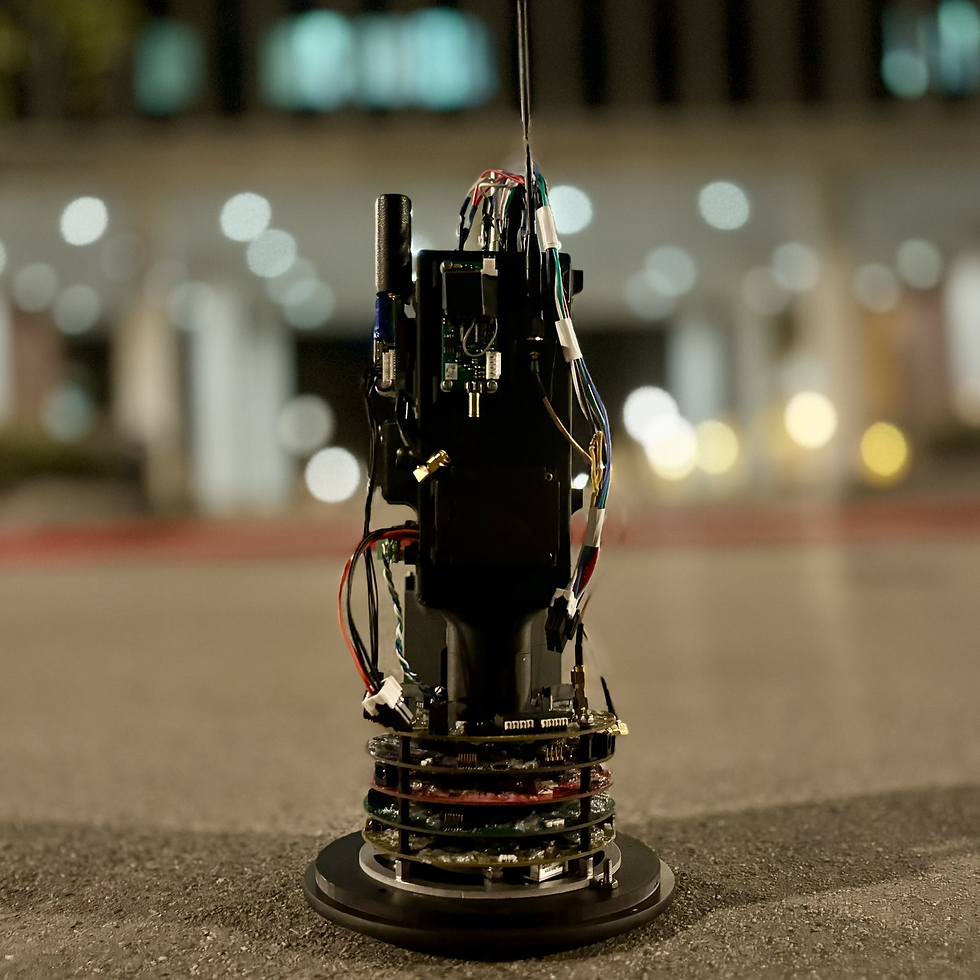
The Avionics system is called HAMSTER, and is entirely developed in-house. It contains datalogging functions, sensors, GPS and everything that a rocket needs to fly. Aftershock is a rare breed of rocket that doesn't fly often; USCRPL will want to get as much data as they can. To avoid a repeat of Traveller IV, when the GPS didn't register during apogee, USCRPL have invented the Lightspeed transponder. Glancing through the paper (https://engrxiv.org/preprint/view/1655/4292), the transponder can accurately register the rocket's position to within 100 meters at apogee.
Recovery
Aftershock uses a single deployment recovery system. At apogee (149km), a CO2 canister will be punctured, pushing the nosecone off and tugging the parachute out. The tether contains a 360 camera and a GPS for tracking, and the parachute will inflate once the rocket reaches the atmosphere. Then, hopefully, Aftershock will hit the ground at a leisurely 65ft/s and land in one piece, cementing USCRPL's place in history!
Good luck to the entire USCRPL team, and may Aftershock fly high!
Sources:
Wikipedia, CSXT (https://en.wikipedia.org/wiki/Civilian_Space_eXploration_Team)
USCRPL, History (https://www.uscrpl.com/history)
USCRPL, Aftershock (http://www.uscrpl.com/aftershock)
USCRPL, Traveller I Report (http://www.uscrpl.com/blog/2013/10/traveler-1-flight-report.html)

