Skyrora - Inspired by black arrows legacy
- Ownittt
- Jul 21, 2024
- 3 min read

Founded on June 21, 2017, Skyrora is a rocket company based in Edinburgh, Scotland, UK. The company was founded with the aim of bettering life on Earth through the delivery of crucial Earth observation satellites responsible for everything to do with natural disasters and also enabling sustainable development during climate change.
How is it inspired by black arrow?
Skyrora's technology for their rockets is inspired by Black Arrow itself, using the same fuel it used, hydrogen peroxide-kerosene. This type of fuel is associated with reducing emissions during launch, providing more of an environmentally free launch area. The black arrow, however, used HTP, which is a form of hydrogen peroxide and is 2% water.

Image: How a H202/kerosene engine works. Credit: Sciencedirect
Meet the fleet
Skylark Nano
Skylark Nano is a short-range, unguided single-stage rocket designed to simulate a larger-scale launch. The Skylark Nano has a built-in parachute recovery system to ensure a safe landing. The third launch of Skylark Nano was on June 13, 2020. The launch was conducted on the Shetland Islands, where Saxavord Spaceport is.

Image: Skylark Nano on its 3rd launch. Credit: Skyrora
Skylark Micro
Skylark Micro is a two-stage rocket that allows electrical systems to be tested under high amounts of G force during lift-off. Like Nano, it uses a built-in parachute recovery system to ensure a safe landing and return of the payload itself. Skylark Micro can be used to test the construction and thermal coating of payload materials. The rocket can also be used to launch small satellites to investigate ambient conditions in areas of dense atmospheric pressure, as well as for educational purposes.
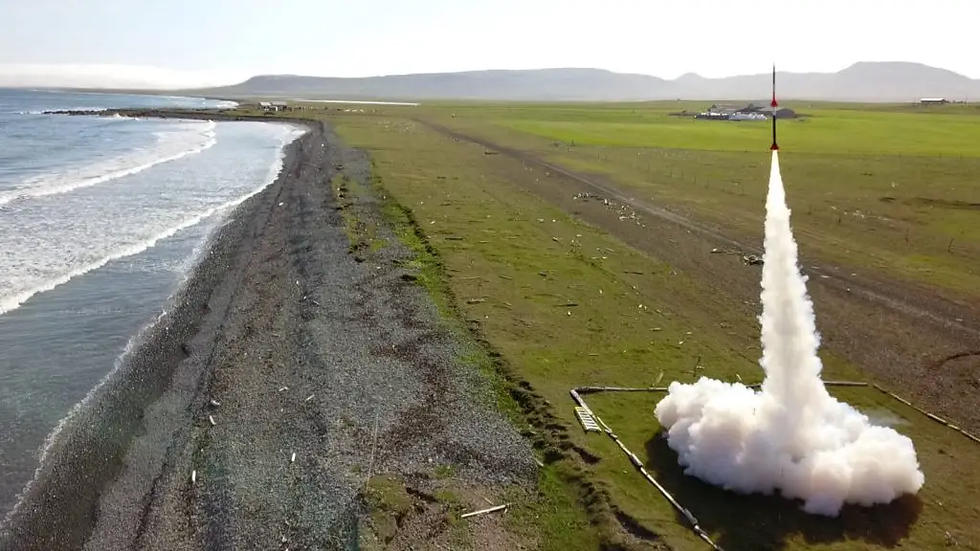
Image: Skylark Micro launching in 2021. Credit: Skyrora
SKYHY
SKYHY is a two-stage hybrid suborbital launch vehicle. It is a hybrid suborbital because the fuel combination consists of solid hydroxyl-terminated polybutadiene (HTPB) and 90% liquid hydrogen peroxide (H202) oxidizer. This rocket is stabilised using its own fins, moving to keep the rocket on course and on a nominal trajectory. SKYHY can have payloads of up to 2 kg, to be tested under the influence of high g-forces. Like the rest of the fleet, SKYHY has a parachute recovery system, so it can safely land with the payload implemented inside the rocket itself.

Image: Skylark Micro launching in 2021. Credit: Skyrora
Skylark L
Skylark L is a single-stage guided sub-orbital launch vehicle powered by HTP or kerosene. Skylark L has an onboard control system, a thrust vector system, and a roll control system used for keeping the rocket on a nominal trajectory. Skylark L first launched from Iceland in 2022; it was Skyrora's first ever attempt to get into space, but it sadly failed due to software complications.

Image: Skylark L on its pad in Iceland. Credit: Skyrora
The biggest of them all... Skyora XL.
Skyrora XL is a three-stage light launch vehicle intended to place payloads into a sun-synchronous orbit (SSO) and polar orbit. Skyrora XL uses inspired fuel from black arrows, using H202/kerosene. The lift-off mass for this launch vehicle is 55,838 KG, and the payload mass is up to 315 KG.

Image: Skyrora XL concept art. Credit: Skyrora
Where will the orbital rocket launch?
Skyrora XL will be launching at the northernmost site, Saxavord Spaceport. The launch will happen somewhere in mid-2025, as they get prepared to test their first stage. Skyrora has applied for a license to launch at Saxavord, so testing on the first stage will not take long.
What has already been tested?
Skyrora XL's second stage has already been tested, as has the engine for the first stage, which completed a 70KN qualification test a few months ago. Skyrora has also tested the third stage, meaning all that needs to be tested now is the complete first stage. Currently, we have no images on Skyron XL's first stage itself, meaning it's still in development, but if they have applied for a launch license at Saxavord, that means good stuff is heading our way.

Image: Skyrora XL 70Kn engine test. Credit: Skyrora
Space Tug
You heard it right, Skyrora XL is developing a space tug to be able to deploy multiple payloads into their specific orbits from the same launch, contributing to sustainability by reducing the number of launches required and reducing emissions altogether. The space tug can also be used for deorbiting space debris and for servicing satellites. Skyrora also plans to deorbit Prospero, the satellite that launched from Black Arrow R3 in 1971.

Wrap up
It is very impressive what Skyrora will do for the UK space industry! Who knows how much potential Skyrora has, but in my opinion, they have quite a lot!
This is Ownitt, signing out!
