Artemis 2 Core Stage Rolled Out
- starship26
- Jul 18, 2024
- 3 min read

As we celebrate the 55th anniversary of the launch of Apollo 11, the first time humans set foot on the Moon, NASA has been hard at work on the next generation of moon rockets. On July 16, NASA rolled out the giant SLS core stage assigned for Artemis 2, the mission that will fly humans around the Moon for the first time in over half a century, from the Michoud Assembly Facility in Louisiana.

Image Credit: NASA
The SLS core stage is designed to hold approximately 2,177,000 lbs (987,470 kgs) of fuel, of which approximately 317,000 lbs (143,790 kgs) are Liquid Hydrogen and 1,860,000 lbs (843,680 kgs) are Liquid Oxygen. At 65 metres tall and 8.4 metres wide, it is nearly as tall as a Falcon 9 (70m) or a Starship Super Heavy Booster (71m). The core stage is powered by four RS-25 engines (the same engines used on the Space Shuttle), each of which provides 418,000 lbs (189,600 kgs) of thrust for an impressive combined total of over 7.4MN (1,670,000 lbs, 757,500 kgs) of thrust. The core stage is comprised of 10 barrel sections, four dome sections and seven rings. The engine section is 6.9m tall and consists of welded aluminium isogrid panels. The liquid hydrogen fuel tank is 40m tall and made of 5 barrel sections. The intertank separates the upper section of the liquid hydrogen tank from the lower section of the liquid oxygen tank while also serving as the forward attachment point for the two solid rocket boosters (SRBs). It is 6.4m tall and contains several important avionics components, including two cameras. The liquid oxygen tank is 15.6m tall. The liquid oxygen is fed to the 4 RS-25 engines via downcomers which exit the intertank on opposite sides and run down the core stage.
The Thermal Protection System (TPS) which is sprayed onto the vehicle is necessary to keep the cryogenic liquid from being heated by the ambient air temperature, which is around 200°C hotter. This spray-on insulation starts off as a more creamy colour, but gets darkened by ultraviolet rays when left in sunlight, giving SLS its iconic orange colour.
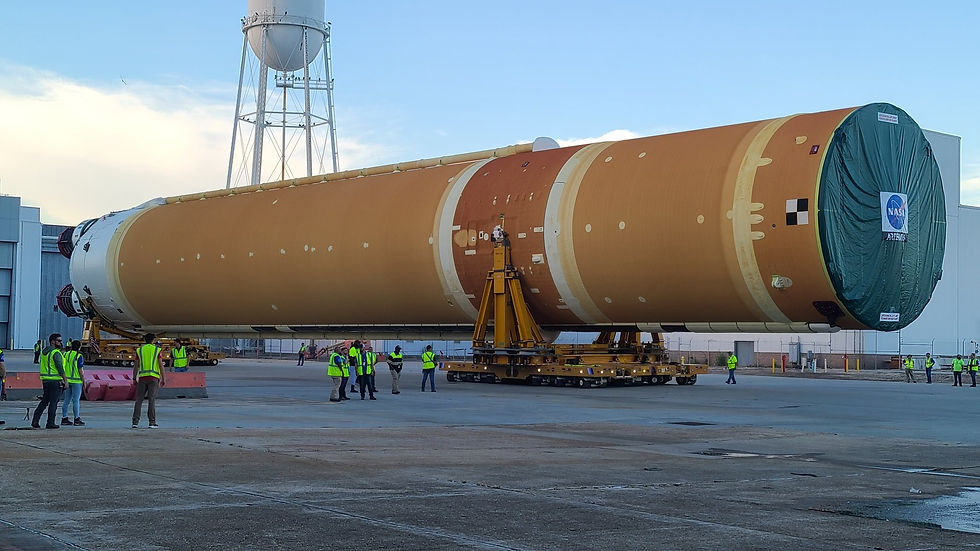
The Core Stage for Artemis II during rollout, the intertank is visibly darker as it is one of the first sections to be sprayed, giving it the most time to age in sunlight. Credit: @LaminarFox on X
Finally, the forward skirt section is placed on top of the liquid oxygen tank, it is 3.2m tall and home to the majority of the vehicle's avionics, as well as hosting many connections to ground infrastructure and support equipment. It connects the core stage to the Integrated Spacecraft/Payload element.

Credit: NASA

Image Credit: NASA
In the coming days, the core stage will be shipped to Cape Canaveral in Florida to begin stacking. Then the launch vehicle stage adapter will be stacked, followed by the ICPS and Orion Spacecraft. Hopefully this will go without issue or delay, until then we can only wait and see.

Artemis II will mark the first time humans will visit the Moon in over 50 years, and will mark a significant milestone in the race with China in returning humans to the Moon to stay. The mission will break many records, such as the most people to be in the sphere of influence of the Moon, the furthest away humans have travelled from Earth (currently held by Apollo 13) and the first woman, first non-american and first person of colour to travel to the Moon. The crew of Artemis II were revealed in April of last year;
Reid Wiseman - Commander, Second Spaceflight
Victor Glover - Pilot, Second Spaceflight
Christina Koch - Mission Specialist - Second Spaceflight
Jeremy Hansen - Mission Specialist - First Spaceflight, Canadian Space Agency
The mission is expected to launch in September 2025, after delays pushed it from 2023. If all goes according to plan, the mission should last approximately 10 days, and bring the crew within 7,400km of the lunar surface.
If successful, it will mark a major milestone in the future of space exploration, and hopefully bring the program to the attention of the general public, along with the same sense of unity and peace that the Apollo Program brought to the world during the Cold War. Spaceflight fans around the world will be watching with bated breath as these brave souls fly on a new rocket around the Moon and back.


