Ariane 6: A rejuvenation of European spaceflight?
- Eve Carruthers
- Jul 14, 2024
- 3 min read


The inaugural flight, known as VA262, was designed to not only provide greater power and flexibility for a lower cost, on Tuesday 9th July, at 19:00 GMT. It came after a series of delays and funding issues that caused the launch to be pushed back from May 2020 6 times. Ariane 6, named after the French version of Ariadne, the Greek mythological character who led the way out of the Minotaur’s labyrinth, lifted off from Europe's Spaceport in French Guiana, 4km west of the Ariane 5 launch pad.
The 183 ft tall heavy lift rocket was powered by a first stage Vulcain 2.1 main engine and a second stage Vinci engine that has been specifically designed for this rocket. Both are cryogenic hydrolox engines -meaning that they use liquid hydrogen and oxygen. This allows the rockets to reach a range of orbits on a single mission, allowing more payloads to be delivered. It also means that the upper stage can burn a number of times and that after separation of the payload, a final deorbit burn can commence to reduce space debris. Ariane 6 can have either 2 or 4 P120 solid rocket boosters (Ariane 62/Ariane 64) depending on what performance is required, both of these are solid fueled. Ariane 62 can launch payloads of approximately 4.5 tonnes into geosynchronous transfer orbit (GTO) or 10.3 tonnes into low Earth orbit. Ariane 64 can launch payloads of approximately 11.5 tonnes into geostationary transfer orbit and 21.6 tonnes into low Earth orbit. For satellites less than 200kg, they can ‘piggyback’ on the launch of the main payload, allowing for more flexibility. ESA says that, “A rideshare ‘multiple launch’ service for small satellites provides cost-effective opportunities for small companies to access the growing space industry.” When launched with a full payload, Ariane 6 will weigh about 900 tonnes. The fairing can also come in 2 sizes, 20m or 14m (both have a diameter of 5.4m), and is made of a carbon fibre-polymer composite that protects satellites from the thermal, acoustic and aerodynamic stresses on the ascent to space.


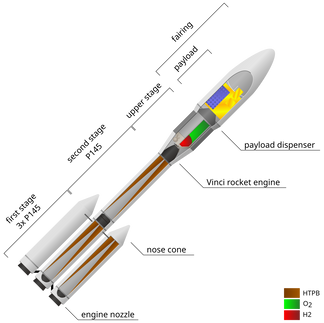
The rocket is able to launch any microsat constellation and can have specialised dispenser structures for certain microsat programs. On the first launch it carried several new satellites and experiments into orbit, including a smart-farming satellite, a radio beacon demonstrator, and capsules designed to re-enter Earth's atmosphere to test new materials.
The latest in Europe’s Ariane series, it features a versatile, modular design to allow for missions into low-Earth orbit and into deeper space. However, it has faced criticism over the lack of reusability and the current high costs of the program in general. European officials have countered this by arguing that Ariane 6 is going to be the provider of independent space access for its member states.
ESA’s Director General, Josef Aschbacher, commented that, “A completely new rocket is not launched often, and success is far from guaranteed. I am privileged to have witnessed this historic moment when Europe's new generation of the Ariane family lifted off – successfully – effectively reinstating European access to space.” He also offered a ‘heartfelt thanks” to all the teams at ESA, CNES, ArianeGroup and ArianeSpace as well as the member states of ESA. Saying that it was “Not always easy, but the endurance shown has paid off handsomely today."

